Most brands running Facebook ads have no idea what their actual ROI target should be. They guess. They panic. They pause ads too early. And they wonder why they can’t scale.
Here’s the method we use with every brand we work with. It starts with two models: a break-even model and a percentage model.
Start With the Break-Even Model
The break-even model answers one question: how much can we spend on ads before we lose money?
To build it, you need a few real inputs. Start with your average monthly orders and your average order value. Use the last 3 to 6 months of data and strip out any big sale periods like Black Friday. You want a clean baseline.
From there, layer in your cost of goods percentage. This is all your variable operating expenses combined. Always round up a few percentage points. You want wiggle room, not false confidence. Then add your fixed costs.
Now the math is simple. Total revenue minus cost of goods minus fixed costs tells you what’s left.
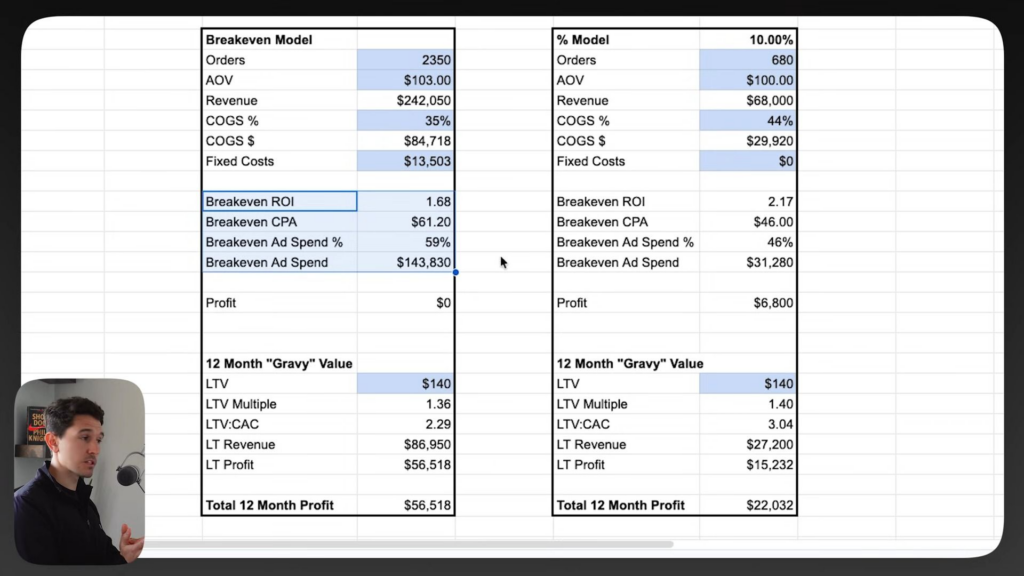
For a real brand we work with, those numbers look like this: 2,350 orders, $103 average order value, 35% cost of goods, and $13K in fixed costs. That puts the break-even return on ad spend at 1.68. It also means we could spend up to 59% of total revenue, which is $143,000, on ads and still break even.
That sounds extreme. But that’s the point. This model shows you the absolute ceiling of what you can spend while still keeping the lights on.
Why Break-Even Is Actually a Growth Strategy
If you spend at break-even, you profit $0 on the first purchase. That sounds terrible. But here’s what most people miss.
Lifetime value changes everything. For this same brand, the 12-month LTV is $128 on a $103 average order value. The LTV to CAC ratio sits at 2. That means running at break-even on first purchase still produces $38,000 in profit over 12 months.
This approach makes sense for two types of businesses. Those just starting out who need momentum. And mature businesses who know their LTV well enough to trust the model. Some of the biggest brands in the world operate at a loss on first purchase and make it back through subscriptions and repeat buying.
The Percentage Model: When You Want to Actually Pay Yourself
Break-even isn’t where most businesses want to live. So we copy the same inputs over to the percentage model and add one new variable: your profit target as a percentage of revenue.
We typically start with 10%. If you’re doing $1M a month, you’re pulling out $100K. Simple.
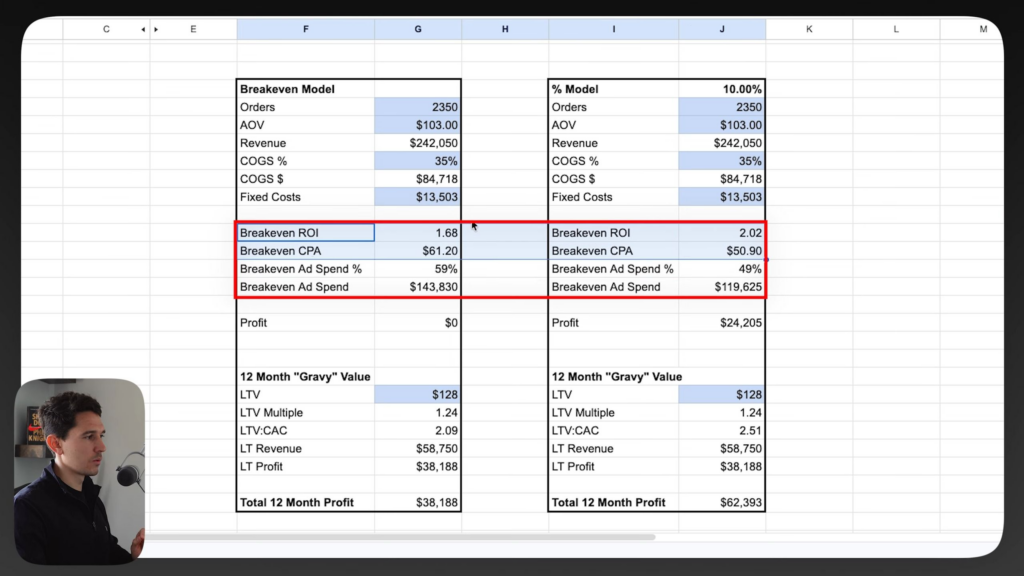
But here’s the trade-off nobody talks about. When you set a 10% profit target, your ROAS target goes from 1.68 up to 2.02. Your available ad spend drops. For this brand, that means roughly $24,000 less in ad spend per month.
Divide that by a $60 CPA and you’re looking at 383 fewer orders every single month. Fewer orders means less revenue. Less revenue means less LTV compounding over time. Your 12-month profit actually drops when you pull too much out too early.
Most owners don’t see this. They pull too much profit, cut ad spend, acquire fewer customers, and find themselves in a slow race to zero.
How to Use Your ROI Target Inside the Ad Account
Once you have your blended ROI target, the next step is using it correctly inside your ad account. And the biggest mistake we see? Pausing ads at the campaign or ad set level based on ROAS alone.
Sorting by spend and killing anything under your ROAS threshold is one of the fastest ways to destroy an account. Performance varies too much at that level to make good decisions.
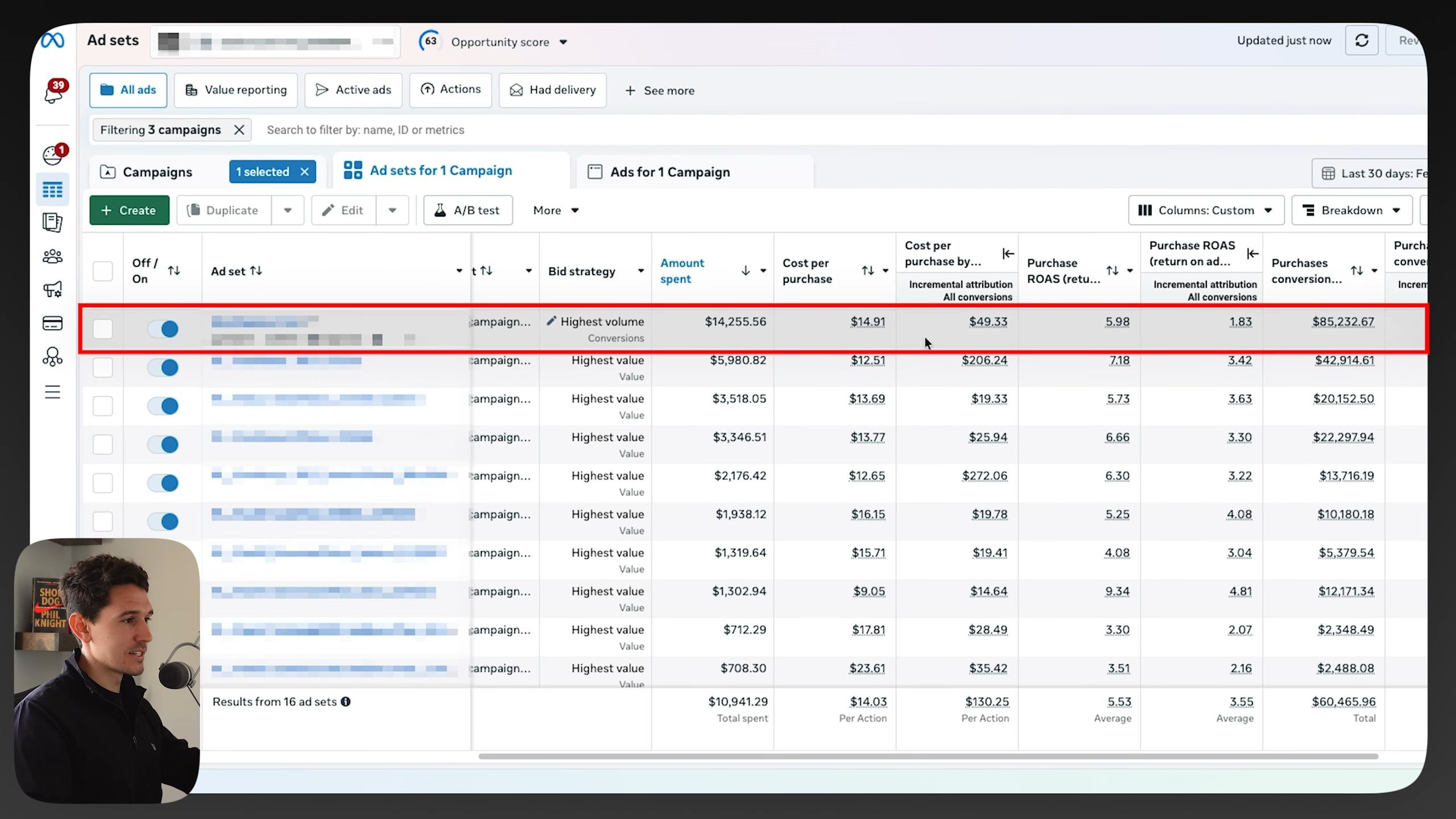
Instead, look at incremental attribution. This shows you which ads are actually causing purchases, not just getting credit for ones that would have happened anyway. An ad set showing a 5.9 ROAS might only have a 1.83 incremental ROAS. If the account average is 3.55, that ad set is dragging performance down significantly.
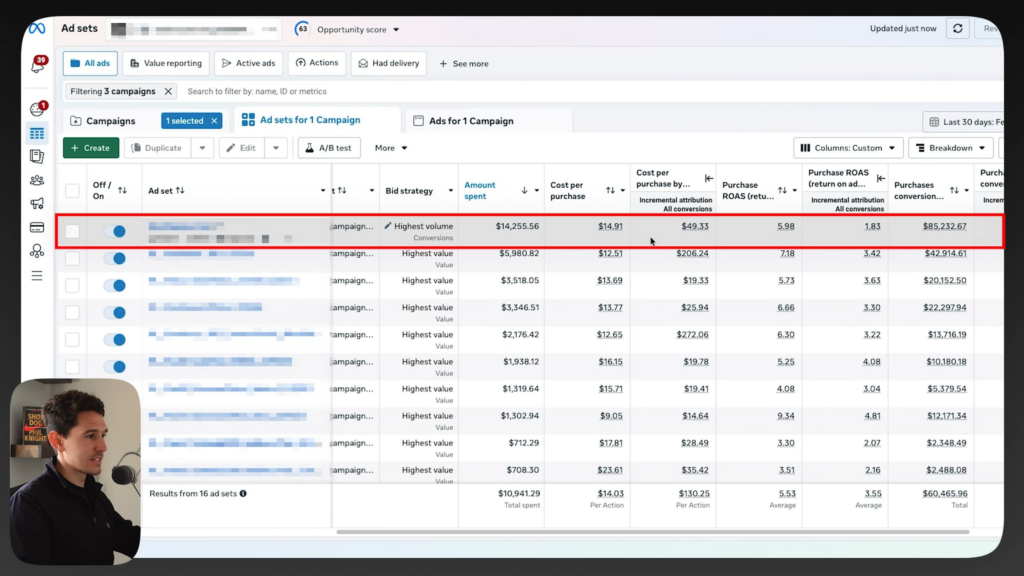
That’s where you pause. Not based on surface-level ROAS. Based on incremental contribution relative to your account average.
The One Thing That’s Impossible to Track
All of this tracking is critical. But there’s one growth driver that no spreadsheet will ever capture: word of mouth.
Every brand you can think of right now, consider how you first heard about them. Maybe it was an ad. But think about how your friend found them. Think about how people talk about products they love. When more people are wearing your shoes, cooking with your air fryer, or telling their friends about your brand, purchases follow. And you’ll never know exactly where those buyers came from.
Word of mouth is the multiplier underneath all of this. The ad spend, the models, the ROI targets all feed into it. The more customers you acquire efficiently, the more that flywheel spins.